

BTrackS Balance Testing (Computerized Posturography)
At Harcourt Brain Center in York, PA, we use the BTrackS Balance Tracking System to measure balance objectively. Instead of guessing how steady you are, BTrackS records your body sway with research-grade accuracy and compares it with people of your age and sex.
What is posturography?
Posturography is the measurement of postural sway, the small, constant movements your body makes to stay upright. Balance depends on three systems working together: your vision, your inner ear (vestibular system), and proprioception (position sense from your feet, joints, and neck). After a concussion, with vertigo, or as we age, one or more of these systems can stop doing its share.
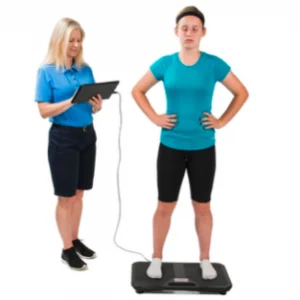
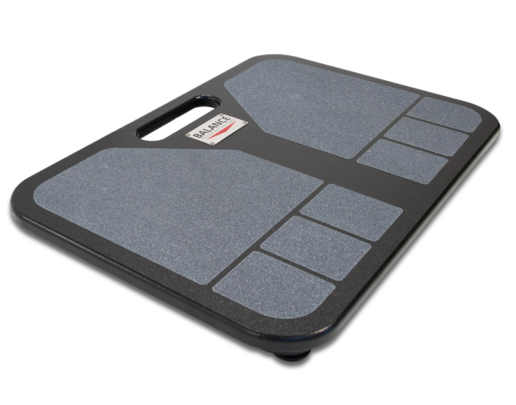
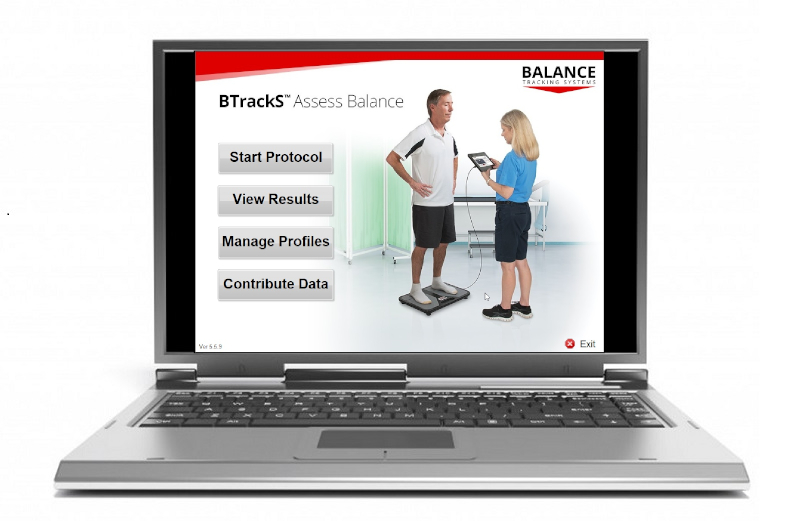
BTrackS is a portable force plate connected to software. As you stand on it, it tracks your center of pressure and calculates how far you sway. Published studies show it agrees almost perfectly with laboratory force plates that cost many times more.
What BTrackS measures
- Balance and fall risk: how much you sway with your eyes closed, compared with people of your age and sex.
- Sensory integration (mCTSIB): balance on firm and foam surfaces with eyes open and closed. This shows whether vision, the inner ear, or proprioception is the weak link.
- Limits of stability: how far you can lean in each direction without stepping.
- Single leg stance: side-to-side differences between your legs.
- Weight distribution and a cervical (neck) challenge test.
How we use it in your care
- Find the cause. Results help show which balance system needs work, so your plan targets the real problem.
- Set a baseline. Your first test gives an objective starting point.
- Track progress. Because the test resists practice and fatigue effects, retesting shows real change over time.
- Train balance. BTrackS biofeedback games, such as target tracking, turn balance training into a measurable exercise.
What to expect
Testing is quick, painless, and noninvasive. You stand still on the plate for a series of short trials, usually about 20 seconds each, sometimes with your eyes closed or while standing on a foam pad. A clinician stays beside you the whole time. Your results appear right away, and we review them with you.
What the research shows
BTrackS lists 22 published studies and reports in its research library. Here are the main takeaways, followed by a summary of each paper.
- It is accurate. In lab testing, BTrackS matched laboratory-grade force plates almost perfectly, with less than 1% error.
- It is reliable. Results stay consistent on repeat testing and are resistant to practice and fatigue effects, so changes reflect real progress.
- Your results are compared with the right peers. Normative data from more than 16,000 people aged 5 to 100 lets us rank your balance by age and sex.
- Balance changes with age. Sway tends to increase from the 40s onward, and balance that relies on vision and the inner ear can start declining in the 30s.
- It detects concussion-related balance changes. 64% of concussed college athletes showed a measurable decline from their baseline within 48 hours.
- It helps estimate fall risk. Older adults in the high-risk group fell about 2.5 times as often as those in the low-risk group over one year.
- Balance can improve with training. Older adults with high sway improved after exercise training, and young adults kept their training gains after stopping.
Start here: a decade of BTrackS research
The Balance Tracking System (BTrackS) for Postural Control Assessment/Training - a Decade of Research
Goble et al., Medical Devices: Evidence and Research, 2025
Main finding: A review of more than 80 BTrackS studies. It concludes BTrackS is valid and reliable compared with traditional force plates, describes 7 testing and 7 training protocols, and reports balance improvements after training programs.
Accuracy and validation
Validating the BTrackS Balance Plate as a low cost alternative for the measurement of sway-induced center of pressure
O'Connor et al., Journal of Biomechanics, 2016
Main finding: Compared with a laboratory-grade force plate using a mechanical sway model, BTrackS showed near-perfect agreement (ICC 0.999) with less than 1% average center-of-pressure error. New and used plates performed the same.
A point of application study to determine the accuracy, precision and reliability of a low-cost balance plate for center of pressure measurement
Goble et al., Journal of Biomechanics, 2018
Main finding: A computer-controlled machine pressed on 21 locations of five plates. Measured and true positions agreed almost perfectly (ICC > 0.999), with average error under 0.4%, and all five plates gave consistent results.
Leveling the playing field: Evaluation of a portable instrument for quantifying balance performance
Richmond et al., Journal of Biomechanics, 2018
Main finding: In 20 healthy adults standing on firm and foam surfaces, 35 of 38 balance measures from BTrackS correlated at 0.98 or higher with a laboratory force plate, supporting it as a valid, lower-cost alternative.
Reliability
BTrackS Balance Test for Concussion Management is Resistant to Practice Effects
Hearn et al., Clinical Journal of Sport Medicine, 2017
Main finding: Twenty healthy young adults tested four times over 15 days showed no practice effect, and test-retest reliability was excellent (ICC 0.92). Repeat testing reflects real change rather than learning the test.
Effects of Fatigue on the BTrackS Balance Test for Concussion Management
Benedict et al., International Journal of Athletic Therapy and Training, 2017
Main finding: Fatigue affected results only immediately after exercise, and scores returned to baseline within 5 minutes. BTrackS appeared more resistant to fatigue than the Balance Error Scoring System (BESS).
Test-Retest Reliability of the Balance Tracking System Modified Clinical Test of Sensory Integration and Balance Protocol Across Multiple Time Durations
Goble et al., Medical Devices: Evidence and Research, 2021
Main finding: In 90 young adults retested day-to-day, week-to-week, or month-to-month, results were stable with fair-to-good reliability and no poor-reliability conditions. Day-to-day vestibular scores showed a small practice effect.
BTrackS limits of stability test is a reliable assessment of volitional dynamic postural control
Haworth et al., Gait & Posture, 2020
Main finding: In 40 young adults, reliability of the Limits of Stability test improved from fair to excellent (ICC 0.92) after the first session. The authors recommend a practice trial before recording results.
Normative (comparison) data
Normative Data for the BTrackS Balance Test of Postural Sway: Results from 16,357 Community-Dwelling Individuals Who Were 5 to 100 Years Old
Goble & Baweja, Physical Therapy, 2018
Main finding: Balance improves through the teen years, stays steady through the 30s, and declines from the 40s onward. Females swayed less than males from age 15 on. Height and weight mattered little, so results are compared by age and sex.
Postural sway normative data across the adult lifespan: Results from 6280 individuals on the Balance Tracking System balance test
Goble & Baweja, Geriatrics & Gerontology International, 2018
Main finding: In adults aged 20 to 100, sway increased significantly from the 40s onward, and women swayed less than men in every age group. Body size explained almost none of the differences.
Normative Data for the BTrackS Balance Test Concussion-Management Tool: Results From 10,045 Athletes Aged 8 to 21 Years
Goble et al., Journal of Athletic Training, 2019
Main finding: Balance in young athletes changes with age and sex, so percentile rankings were created by sex and 2-year age group to compare an injured athlete with peers.
Normative data for the Balance Tracking System modified Clinical Test of Sensory Integration and Balance protocol
Goble et al., Medical Devices: Evidence and Research, 2019
Main finding: In 604 adults aged 18 to 29, women swayed less than men in all four sensory conditions, with the biggest difference on foam with eyes closed. Percentile tables were provided by sex and condition.
Expanded normative data for the balance tracking system modified clinical test of sensory integration and balance protocol
Goble et al., Medical Devices & Sensors, 2020
Main finding: In 1,276 adults aged 20 to 59, balance using vision and vestibular (inner ear) input began declining in the 30s, while other conditions declined in the 50s.
Developmental normative data for the Balance Tracking System modified Clinical Test of Sensory Integration and Balance protocol
Goble et al., Journal of Experimental Child Psychology, 2025
Main finding: In 1,246 people aged 5 to 29, balance improved from childhood into young adulthood, and females generally swayed less than males. This gives reference values for children and teens.
An initial set of reference values for the Balance Tracking System (BTrackS) Limits of Stability protocol
Nolff et al., Gait & Posture, 2023
Main finding: In 800 young adults, height and sex predicted how far a person can lean without stepping. Reference tables were provided by sex and height.
Lower Limb Asymmetry Evaluation Using the Balance Tracking System (BTrackS) Single Leg Stance Protocol
Nolff et al., Journal of Motor Behavior, 2022
Main finding: In 161 healthy young adults, there was no typical left-right leg difference. A side-to-side difference of 16% or more was identified as beyond normal.
Clinical applications
An Initial Evaluation of the BTrackS Balance Plate and Sports Balance Software for Concussion Diagnosis
Goble et al., International Journal of Sports Physical Therapy, 2016
Main finding: Of 25 college athletes tested within 48 hours of a concussion, 16 (64%) showed a meaningful balance decline from their preseason baseline. Balance testing is one part of a complete concussion evaluation.
Valid Predictor of Older Adult Falling
Goble, Balance Tracking Systems report, 2018
Main finding: Over one year, 107 adults aged 70+ fell at rates of 29%, 42%, and 51% in the low, moderate, and high fall-risk groups. High-risk participants were about 2.5 times more likely to fall. (Company report, not a journal article.)
Combination of BTrackS and Geri-Fit as a targeted approach for assessing and reducing the postural sway of older adults with high fall risk
Goble et al., Clinical Interventions in Aging, 2017
Main finding: After 90 days of exercise training, every older adult in the higher-sway group reduced their sway, and 71% improved beyond the test's minimum detectable change.
Six Weeks of at Home BTrackS Target Tracking Training Induces Sustained Dynamic Balance Improvement in Healthy Young Adults
Conner et al., Medical Devices: Evidence and Research, 2023
Main finding: Fifteen adults trained at home for 3 minutes, about five times a week. Their limits of stability increased, and the gains were still present three weeks after training stopped.
Normative percentile ranking best reveals sensorimotor impairments of postural sway in type 2 diabetes
Lopatin et al., Research Methods in Medicine & Health Sciences, 2024
Main finding: People with type 2 diabetes swayed more than matched peers. Comparing each person with normative percentiles revealed individual impairment patterns that group averages missed.
BTrackS: A Low-Cost, Portable Force Plate for Objectively Measuring Balance Deficits and Fall Risk
Goble et al., Home Healthcare Now, 2019
Main finding: Describes how BTrackS gives objective, age- and sex-matched balance and fall-risk results in a portable, USB-powered device suitable for clinics and home health.
Research summaries are based on the studies listed in the BTrackS resource library. Most studies were authored or co-authored by researchers involved in developing BTrackS. Product images courtesy of Balance Tracking Systems, Inc. BTrackS provides objective information about balance and is not used by itself to diagnose any medical condition; we interpret results alongside a full neurological exam.
Have questions about testing?
Call 717-483-8734 or request a consultation to find out whether this testing is right for you.