
Sinusoidal Rotational Testing (Rotary Chair)
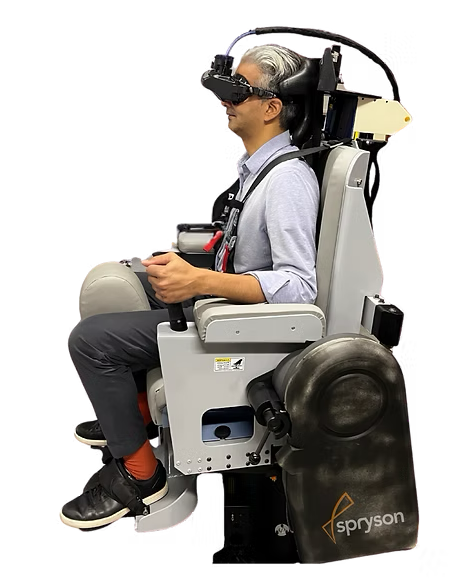
Rotational chair testing measures how well your inner ears and brain work together to keep your vision steady when your head moves. Our rotary chair is the Neuro Otologic Test Center (NOTC) from Spryson America (formerly Neuro Kinetics). This FDA-cleared system is used by leading universities and medical centers for vestibular testing.
How it works
You sit in a comfortable, computer-controlled chair inside an enclosed testing booth while wearing infrared eye-tracking goggles. A camera and two-way intercom let our clinician see you and talk with you the entire time.
In sinusoidal harmonic acceleration testing, the chair gently turns back and forth at a series of set speeds. Each time your body turns, your inner ears signal your eyes to move the opposite way. This is called the vestibulo-ocular reflex (VOR). The goggles measure how accurately, how quickly, and how evenly your eyes respond:
- Gain: the size of the eye response compared with the chair movement.
- Phase: the timing of the eye response.
- Symmetry: whether responses to the left and right are balanced.
More than one test
The NOTC combines the rotary chair with a laser target, an optokinetic light stimulus, and 3D eye tracking, so one session can include several tests (FDA 510(k) K181025):
- Sinusoidal rotation testing of the VOR
- Computer-controlled head impulse testing in the chair
- Optokinetic, smooth pursuit, and saccade testing
- Subjective visual vertical and horizontal, including testing during off-center rotation (unilateral centrifugation) to assess each inner ear’s otolith organs
- Reaction time testing
Why it is useful
Because the chair moves your whole body, it tests both inner ears together across a range of everyday head speeds without putting water or air in your ears. That makes it especially helpful for:
- Chronic dizziness, vertigo, or imbalance
- Finding reduced function in both inner ears
- Post-concussion syndrome with dizziness or visual motion sensitivity
- Vestibular migraine
- Measuring how well the brain is compensating, and tracking progress during vestibular rehabilitation
See our rotary chair in the FOX43 Health Smart feature on concussion care.
What the research shows
Research using the Neuro Kinetics NOTC rotary chair has measured concussion-related changes and set normal reference ranges.
Oculomotor, Vestibular, and Reaction Time Tests in Mild Traumatic Brain Injury
Balaban, Hoffer et al., PLOS ONE, 2016
Main finding: Using the Neuro Kinetics I-Portal NOTC rotary chair and video-oculography goggles, researchers tested two groups of 50 people with mild TBI and 100 controls each. A small set of eye-movement and rotational measures identified concussion with 89% sensitivity and 97.5% specificity (AUC above 0.97).
Normative data for ages 18-45 for ocular motor and vestibular testing using eye tracking
Kullmann et al., Laryngoscope Investigative Otolaryngology, 2021
Main finding: The companion study set 95% reference ranges for optokinetic, subjective visual vertical and horizontal, and rotational chair tests in 290 to 449 healthy adults. Age and gender had no meaningful effect, so one set of normal ranges applies across this age group.
The use of oculomotor, vestibular, and reaction time tests to assess mild traumatic brain injury (mTBI) over time
Hoffer et al., Laryngoscope Investigative Otolaryngology, 2017
Main finding: In 106 people with mild TBI and 300 matched controls, the test battery identified concussion at the first visit with 84.9% sensitivity and 97% specificity. Repeat testing over two weeks tracked recovery, and many patients still tested abnormal at the last visit.
Portable eye-tracking as a reliable assessment of oculomotor, cognitive and reaction time function: Normative data for 18-45 year old
Kullmann et al., PLOS ONE, 2021
Main finding: Normative data from 466 healthy adults aged 18 to 45, collected on the Neurolign/Neuro Kinetics NOTC chair and portable VOG goggles, set reference ranges for saccades, smooth pursuit, antisaccades, predictive saccades, and reaction time.
Product images courtesy of Spryson America, Inc. The NOTC records and measures responses; it does not make a diagnosis on its own. Results are interpreted by our clinicians alongside your history and a full neurological exam.
Have questions about testing?
Call 717-483-8734 or request a consultation to find out whether this testing is right for you.