
Cervical Spine Proprioceptive Retraining
Your neck does more than hold up your head. It is packed with position sensors that help your brain know where your head is in space. When those signals are off, after whiplash, a concussion, or long-term neck pain, you can feel dizzy, unsteady, or foggy. Cervical spine proprioceptive retraining helps restore accurate signals.
Why the neck affects balance
The brain combines information from your eyes, inner ears, and neck to keep you balanced and your vision steady. Research shows that people with neck pain often have impaired neck position sense, which can contribute to dizziness, unsteadiness, headaches, and visual disturbances. This is sometimes called cervicogenic dizziness.
How we evaluate it
- Joint position error testing: with your eyes closed, you return your head to a center target. We measure how far off you land.
- Eye-head coordination tests to see how well your eyes and neck work together.
- Balance testing with neck challenges, such as the BTrackS cervical protocol, to see how neck input affects your stability.
What retraining involves
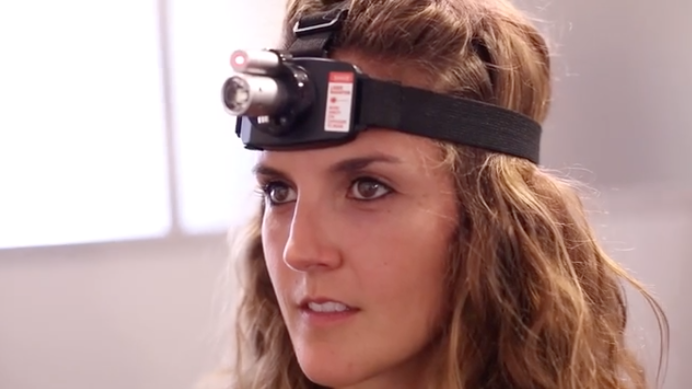
- Precise head-relocation exercises using laser or target feedback
- Gaze stability and eye-head coordination drills
- Balance exercises that gradually add head and neck movement
- Gentle manual therapy when appropriate, as part of a complete plan
Exercises are progressed as your accuracy improves and can be continued at home.
Who it can help
- Whiplash and auto accident injuries
- Post-concussion syndrome with neck pain, headaches, or dizziness
- Chronic neck pain with unsteadiness or visual symptoms
- Cervicogenic headache
Further reading
- Cervical Proprioception Impairment in Neck Pain-Pathophysiology, Clinical Evaluation, and Management: A Narrative Review. Pain and Therapy, 2021
- Proprioceptive Cervicogenic Dizziness: A Narrative Review of Pathogenesis, Diagnosis, and Treatment. PubMed Central
- Sensorimotor Function and Dizziness in Neck Pain: Implications for Assessment and Management. Journal of Orthopaedic & Sports Physical Therapy, 2009
Have questions about testing?
Call 717-483-8734 or request a consultation to find out whether this testing is right for you.