
Dysautonomia & POTS Treatment in York, PA
Evidence-based rehabilitation at Harcourt Brain Center
Harcourt Brain Center in York, Pennsylvania helps people living with dysautonomia and postural orthostatic tachycardia syndrome (POTS). If standing up makes your heart race, leaves you lightheaded, foggy or exhausted, or brings on headaches and dizziness, your autonomic nervous system may not be adjusting the way it should. Dr. Adam Harcourt builds a personalized plan around the non-drug treatments with the best research support, and we work alongside your primary care doctor, cardiologist or neurologist, who handle diagnosis and medication.
To see how we weigh the research behind all of our care, read our Clinical Rationale & Evidence page.
ABOUT DYSAUTONOMIA & POTS
Dysautonomia is a general term for problems with the autonomic nervous system, the part of the nervous system that automatically controls heart rate, blood pressure, digestion and temperature. POTS is the most common form we see. It is defined by symptoms when upright plus a sustained heart rate increase of at least 30 beats per minute (40 or more in teens ages 12–19) within 10 minutes of standing, without a large drop in blood pressure.[1][2] POTS is estimated to affect 0.1% to 1% of the U.S. population, and in 30% to 40% of cases symptoms begin within 3 months after an infection such as COVID-19, Epstein-Barr virus or the flu.[1]
Who We Help
Many of our dysautonomia and POTS patients also live with conditions we treat every day:
- Concussion: at one large children’s hospital, 11.4% of people diagnosed with POTS reported their symptoms began within 3 months of a concussion.[4]
- Migraine: migraine is a commonly reported condition in people with POTS, with a pooled prevalence of about 37% across published studies.[5]
- Dizziness and imbalance: lightheadedness on standing often overlaps with vestibular (inner-ear) dizziness, neck-related dizziness and vestibular migraine.
- After a virus: including long COVID.[1]
Common symptoms include: a racing or pounding heart when standing, lightheadedness or near-fainting, brain fog, fatigue, headaches, shakiness, nausea, poor exercise tolerance, and feeling worse in heat or after standing still.
Your First Evaluation
Your first visit includes a detailed history and a functional neurological exam. Depending on your symptoms, it can include:
- Checking how your heart rate and blood pressure respond when you move from lying down to standing
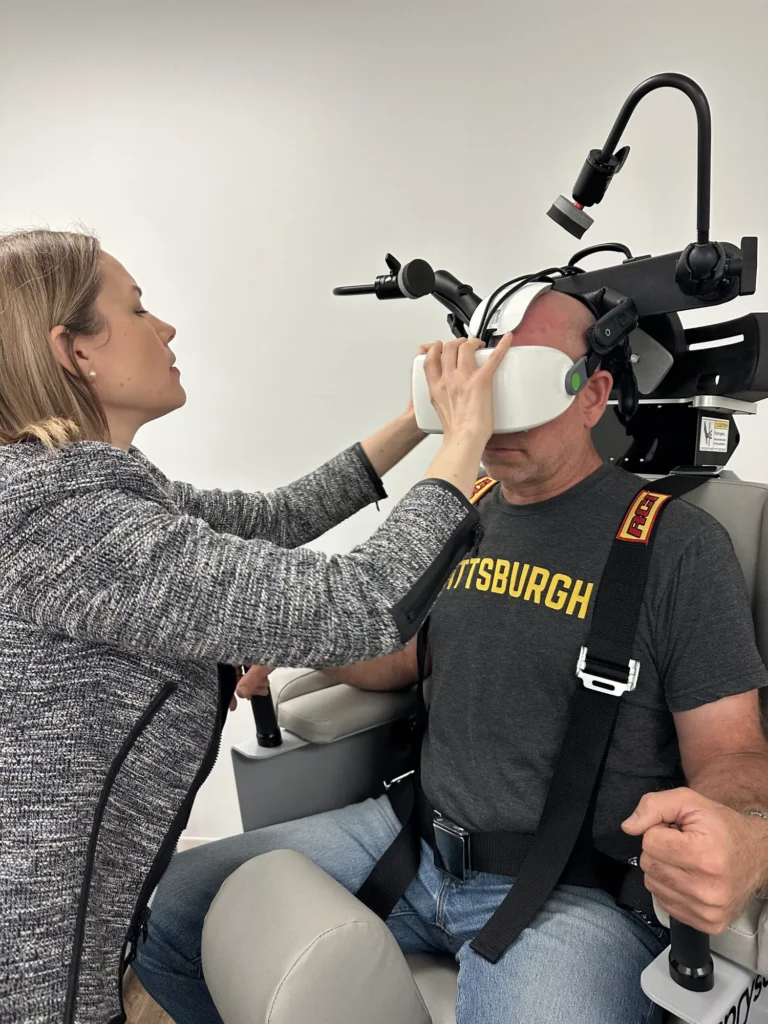
- VOG eye-movement testing and rotary chair testing of the inner-ear reflexes
- BTrackS computerized balance testing
- An exam of your neck, posture and coordination
A racing heart can also come from thyroid problems, anemia, dehydration, heart conditions or certain medications, so these need to be ruled out by your medical doctor.[1] If you haven’t had that workup, we will refer you. A formal POTS diagnosis is made by a physician, often with a tilt-table or standing test.
What the Research Does and Doesn’t Show
Exercise training and compression have the most consistent support for POTS, and consensus experts list them as first-line, non-drug care.[1][3] Even so, most POTS trials are small, and large randomized trials are still needed for nearly every treatment.[18] Vestibular rehabilitation, manual therapy and laser therapy have solid evidence for the dizziness and pain that often come with dysautonomia, but not as cures for POTS. Results vary from person to person, and we’ll be straightforward with you about what to expect.
Dr. Harcourt has also presented his own clinical work in this area, including a 2016 case report on dysautonomia and migraine published as a conference abstract in Frontiers in Neurology. See his research and media appearances.
Evidence-Based Treatments We Use
No single treatment works for everyone with POTS, and most research studies are small.[18] That’s why each plan is matched to your exam findings and adjusted as you progress. These are the treatments we use, and what the research shows for each.
1. Neuro-Rehabilitation and Graded Exercise Reconditioning
A structured, gradually increasing exercise program has the strongest research support of any non-drug treatment for POTS.[1][3] In a study at UT Southwestern, 3 months of training increased heart size and blood volume, lowered standing heart rate, and 10 of 19 patients no longer met POTS criteria.[6] A follow-up study found exercise training improved quality of life more than the heart medication propranolol.[7] In a community program, 71% of the 103 patients who completed training no longer qualified for POTS afterward.[8]
Because standing triggers symptoms, we start with lying-down and seated exercise such as a recumbent bike or rowing, then progress toward upright activity as your tolerance improves.[9] This is paired with brain-based neuro-rehabilitation exercises for eye movement, coordination and sensory integration based on your exam. If you have post-exertional crashes, as some people with long COVID or chronic fatigue do, we progress more slowly and adjust the dose visit by visit.
Non-invasive nerve stimulation: when appropriate, we may add gentle stimulation of the vagus nerve through the ear. In a 2024 randomized, sham-controlled trial in women with POTS, 2 months of daily ear stimulation reduced the rise in heart rate on standing (about 18 vs. 32 beats per minute with sham) without device-related side effects.[10] This is promising but still early research.
2. Vestibular Rehabilitation
Vestibular rehabilitation uses targeted head, eye and balance exercises to retrain the inner ear and brain. A Cochrane review of 39 trials with 2,441 participants found moderate to strong evidence that it is safe and effective for inner-ear (vestibular) dizziness.[11] A 2026 meta-analysis also found meaningful improvement in dizziness for people with vestibular migraine.[12] The vestibular system also helps adjust blood pressure when you stand.[13] We use vestibular rehabilitation when your exam shows the inner ear is contributing to your dizziness. It isn’t a stand-alone treatment for POTS.
3. Balance Training
Lightheadedness, deconditioning and inner-ear problems can all make you unsteady. We measure your balance with BTrackS and build balance training into your vestibular and exercise program, progressing from supported positions to standing and moving as your heart rate tolerance allows. Clinical guidance for POTS after concussion recommends building an individualized POTS exercise program into concussion rehabilitation, starting with lying-down exercise.[4]
4. Manual Therapies
Neck pain and stiffness are common in our dysautonomia patients, and problems in the neck can cause their own type of dizziness. A systematic review found moderate-quality evidence that manual therapy reduces neck-related (cervicogenic) dizziness, neck symptoms and balance problems, with stronger effects when combined with exercise.[14] To be clear, a 2024 meta-analysis found that spinal manipulation did not reliably change autonomic measures compared with sham treatment.[15] We use gentle manual therapy for neck pain and neck-related dizziness, not as a way to “reset” the nervous system.
5. Low Level Laser Therapy
Our Erchonia low-level laser (photobiomodulation) is FDA-cleared for pain. A Lancet meta-analysis of 16 randomized trials with 820 patients found that it reduced neck pain right after treatment for acute pain, and for up to 22 weeks after treatment for chronic neck pain, with side effects no different from placebo.[16] We use it for the neck pain and muscle tension that often come with dysautonomia. There isn’t research showing it treats POTS itself.
6. Daily Strategies, Coordinated With Your Doctor
First-line POTS care also includes more fluids and salt, compression garments, and avoiding heat, dehydration and prolonged standing.[1] In a randomized crossover study, combined lower-body and abdominal compression lowered heart rate during tilt testing from about 109 to 92 beats per minute and improved symptoms.[17] We help you put these habits into practice. Please check with your physician before increasing salt, especially if you have high blood pressure or kidney or heart disease. We don’t start or change medications.
What Our Patients Say
Real reviews from dysautonomia, POTS and long COVID patients and families on Google
“Two days before treatment, our child went to an outdoor venue with a rollator and needed to sit several times walking less than 100 feet ... Two days after we ended treatment, at the same venue, she walked without assistance and DANCED STANDING UP for more than an hour”
5 out of 5 stars on Google · Parent of a patient
“He was the only Doctor to diagnose my conditions accurately and then solve them. He’s patient, caring, respectful, trustworthy, flexible and willing to make adjustments as needed.”
5 out of 5 stars on Google
Frequently Asked Questions
Where can I get dysautonomia or POTS rehabilitation in York, PA?
Harcourt Brain Center, at 221 W. Philadelphia St., Suite 303 in York, PA, offers graded exercise reconditioning, neuro-rehabilitation, vestibular rehabilitation, balance training, manual therapy and low-level laser therapy for people with dysautonomia and POTS. Call 717-483-8734 to schedule.
Can POTS start after a concussion or a virus?
Yes. Symptoms often begin within 3 months after an infection such as COVID-19, and POTS is increasingly recognized after concussion. We evaluate both the autonomic and the brain and inner-ear side of these symptoms.
Is exercise safe if I have POTS?
For most people, a carefully graded program is one of the best-supported treatments. We start with lying-down and seated exercise, progress slowly, and adjust if activity triggers a crash. Talk with your physician first if you have fainting, chest pain or a known heart condition.
Will I still need my cardiologist or medications?
Typically patients have already been through a full cardiac workup prior to being seen in our office. If not, we will recommend that you rule out any cardiovascular components to your condition. We work alongside your medical team and have them advise you on the best course of action for any medications you are currently taking.
References
- Chung TH, Raj SR. Postural Orthostatic Tachycardia Syndrome (POTS): A Review. JAMA. 2026;336(13):1149-1164. PubMed 42635998
- Sheldon RS, et al. 2015 Heart Rhythm Society expert consensus statement on the diagnosis and treatment of postural tachycardia syndrome, inappropriate sinus tachycardia, and vasovagal syncope. Heart Rhythm. 2015;12(6):e41-63. PubMed 25980576
- Vernino S, et al. Postural orthostatic tachycardia syndrome (POTS): State of the science and clinical care from a 2019 National Institutes of Health Expert Consensus Meeting – Part 1. Auton Neurosci. 2021;235:102828. PubMed 34144933
- Miranda NA, et al. Activity and Exercise Intolerance After Concussion: Identification and Management of Postural Orthostatic Tachycardia Syndrome. J Neurol Phys Ther. 2018;42(3):163-171. PubMed 29864098
- Ray JC, et al. The prevalence of headache disorders in Postural Tachycardia Syndrome: A systematic review and meta-analysis of the literature. Cephalalgia. 2022. PubMed 35469447
- Fu Q, et al. Cardiac origins of the postural orthostatic tachycardia syndrome. J Am Coll Cardiol. 2010;55(25):2858-68. PubMed 20579544
- Fu Q, et al. Exercise training versus propranolol in the treatment of the postural orthostatic tachycardia syndrome. Hypertension. 2011;58(2):167-75. PubMed 21690484
- George SA, et al. The international POTS registry: Evaluating the efficacy of an exercise training intervention in a community setting. Heart Rhythm. 2016;13(4):943-50. PubMed 26690066
- Fu Q, Levine BD. Exercise and non-pharmacological treatment of POTS. Auton Neurosci. 2018;215:20-27. PubMed 30001836
- Stavrakis S, et al. Noninvasive Vagus Nerve Stimulation in Postural Tachycardia Syndrome: A Randomized Clinical Trial. JACC Clin Electrophysiol. 2024;10(2):346-355. PubMed 37999672
- McDonnell MN, Hillier SL. Vestibular rehabilitation for unilateral peripheral vestibular dysfunction. Cochrane Database Syst Rev. 2015;1:CD005397. PubMed 25581507
- El Ahdab J, et al. The effect of vestibular rehabilitation in the management of vestibular migraine in adults: A systematic review and meta-analysis. Headache. 2026. PubMed 41288240
- Ray CA, Carter JR. Vestibular activation of sympathetic nerve activity. Acta Physiol Scand. 2003;177(3):313-9. PubMed 12609001
- De Vestel C, et al. Systematic review and meta-analysis of the therapeutic management of patients with cervicogenic dizziness. J Man Manip Ther. 2022;30(5):273-283. PubMed 35383538
- Kovanur Sampath K, et al. Effectiveness of spinal manipulation in influencing the autonomic nervous system – a systematic review and meta-analysis. J Man Manip Ther. 2024;32(1):10-27. PubMed 38044657
- Chow RT, et al. Efficacy of low-level laser therapy in the management of neck pain: a systematic review and meta-analysis of randomised placebo or active-treatment controlled trials. Lancet. 2009;374(9705):1897-908. PubMed 19913903
- Bourne KM, et al. Compression Garment Reduces Orthostatic Tachycardia and Symptoms in Patients With Postural Orthostatic Tachycardia Syndrome. J Am Coll Cardiol. 2021;77(3):285-296. PubMed 33478652
- Kwok CS, et al. The evidence for treatments for postural orthostatic tachycardia syndrome: a systematic review of randomized trials. Trends Cardiovasc Med. 2025;35(8):517-527. PubMed 40653179
This page is for education and doesn’t replace care from your physician. If you faint and are injured, or have chest pain, shortness of breath or a sudden severe headache, call 911 or go to the nearest emergency room.